
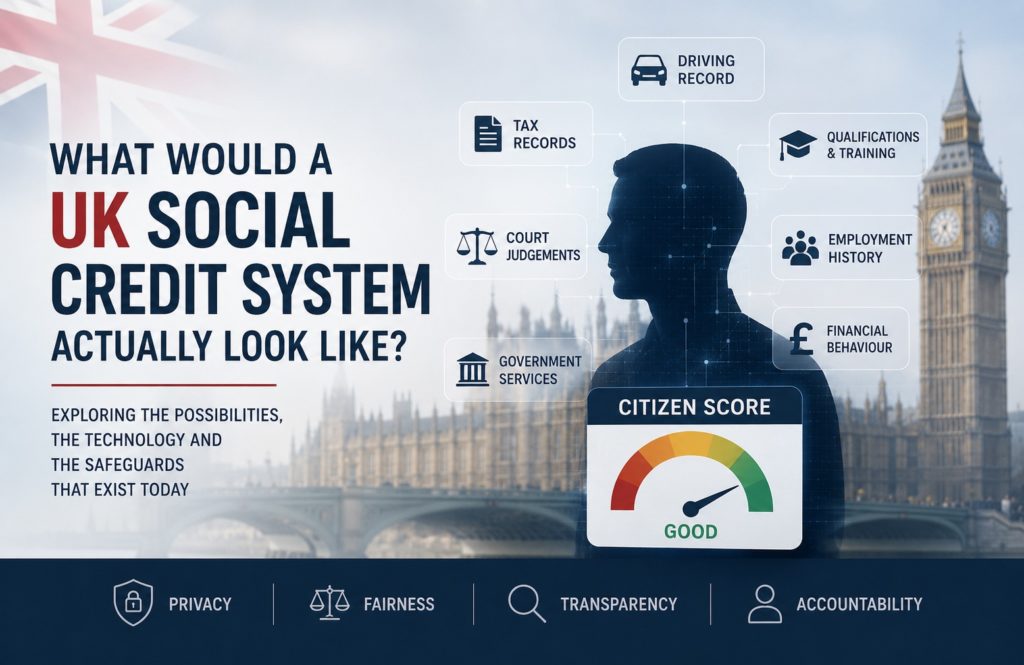
There is currently no social credit system in the UK. However, as technology continues to evolve, many people are asking whether one could ever exist and what it might actually look like.
This article explores the possibilities, the technologies involved and the legal safeguards that currently exist.
“`
What Is a Social Credit System?
“`
A social credit system is a framework that assesses individuals or organisations based on specific behaviours, records or data.
The term is most commonly associated with China, although the reality of the Chinese system is often more complex than media headlines suggest.
In theory, a social credit system could combine information from multiple sources to create a profile, rating or score that influences access to certain services, opportunities or benefits.
Importantly, the UK does not currently operate a national social credit system, and there are no confirmed plans to introduce one.
“`
Could the UK Introduce a Social Credit System?
“`
From a technical perspective, almost any country could develop systems that combine information from government departments, financial organisations and other approved data sources.
Whether such a system would be politically, legally or socially acceptable in the UK is a very different question.
The UK has established protections relating to privacy, data protection, equality and human rights. A proposal to create a comprehensive citizen scoring system would therefore be likely to face substantial legal scrutiny, parliamentary debate and public opposition.
“`
What Information Could Be Included?
“`
If a hypothetical UK social credit system were ever created, it might draw information from a range of official records.
Potential data sources could include:
- Electoral registration records
- Driving licence information
- Criminal convictions
- Tax records
- Court judgments
- Benefit claims
- Immigration records
- Business directorships
- Professional licences
- Identity verification records
- Financial information where legally permitted
Some commentators also speculate that future scoring systems could use newer forms of data.
These might include:
- Digital identity information
- Online reputation data
- AI-powered fraud assessments
- Publicly available social media activity
- Verified qualifications
- Employment history
- Public-sector compliance records
However, there is no evidence that these datasets are currently being combined to create a single national social credit score for UK citizens.
“`
Would Everyone Receive a Single Score?
“`
A UK system would not necessarily involve one universal number displayed against every citizen.
If anything similar were ever developed, it would be more likely to consist of separate risk assessments used for specific purposes.
Organisations already use specialist scoring and assessment systems for areas such as:
- Credit and lending decisions
- Insurance risk assessments
- Fraud prevention
- Identity verification
- Employment background checks
- Mortgage affordability
- Security vetting
- Anti-money-laundering checks
These systems usually assess a specific type of risk. They are not currently combined into a single government-controlled behavioural score.
“`
How Could a UK Social Credit Score Work?
“`
A hypothetical UK system could operate by collecting authorised information, evaluating it against a set of rules and assigning an individual to a risk or trust category.
A possible process might include:
- Information is collected from approved sources.
- The information is checked against established criteria.
- An algorithm or decision-making system assesses the data.
- The individual is assigned a score, rating or risk category.
- The result is used when determining access to a service or opportunity.
- The individual is given a way to challenge incorrect information or decisions.
Such a system could potentially reward certain behaviours, penalise others or simply identify individuals who require additional checks.
The exact outcome would depend on who operated the system, what information was used and which decisions the score was permitted to influence.
“`
Could Artificial Intelligence Play a Role?
“`
Artificial intelligence can analyse large volumes of information more quickly than traditional manual processes.
In a hypothetical future system, AI could potentially be used to:
- Detect fraudulent claims
- Identify possible identity theft
- Spot unusual financial activity
- Automate routine administrative decisions
- Prioritise cases for investigation
- Identify inconsistencies between records
- Calculate risk levels
The use of AI would also raise serious concerns about accuracy, bias, transparency and accountability.
An automated system can only be as reliable as the information and rules on which it is based. Incorrect, incomplete or biased data could lead to unfair decisions.
“`
What Role Could Digital Identity Play?
“`
Digital identity is becoming increasingly important as more government and commercial services move online.
A digital identity allows someone to prove who they are electronically instead of repeatedly providing physical documents.
Potential benefits include:
- Faster identity checks
- Reduced identity fraud
- Easier access to online services
- Secure document verification
- Less reliance on paper records
- More efficient government administration
Some people are concerned that digital identity systems could eventually be connected to wider behavioural or risk assessments.
At present, however, digital identity and social credit scoring are different concepts. Verifying who someone is does not automatically mean assessing how they behave.
“`
What Could Affect a UK Social Credit Score?
“`
In a hypothetical system, the factors affecting a score would depend entirely on the objectives set by the organisation operating it.
Possible positive factors might include:
- Paying taxes and fines on time
- Maintaining accurate official records
- Holding verified professional qualifications
- Complying with court orders
- Maintaining a reliable financial history
Possible negative factors might include:
- Unpaid court judgments
- Repeated fraud convictions
- Providing false information to public bodies
- Outstanding financial penalties
- Serious regulatory breaches
More controversial proposals might attempt to include lifestyle choices, online activity, associations or political behaviour.
These types of criteria would create significant concerns about freedom of expression, discrimination, privacy and government overreach.
“`
What Could a Social Credit Score Be Used For?
“`
Depending on how it was designed, a social credit-style system could potentially influence access to a range of services.
Possible uses might include:
- Public-sector fraud prevention
- Eligibility checks for government services
- Security clearance decisions
- Business licensing
- Financial risk assessments
- Identity verification
- Immigration checks
- Access to regulated professions
A highly restrictive system could go much further by connecting scores to transport, housing, employment, education or access to public services.
This would be far more controversial and would require significant changes to UK law.
“`
Would People Be Rewarded for Good Behaviour?
“`
Some social credit proposals focus not only on penalties but also on rewards.
A hypothetical reward-based model could offer benefits such as:
- Faster access to certain services
- Reduced administrative checks
- Preferential financial terms
- Lower deposits
- Access to selected public incentives
Supporters might argue that this encourages responsible behaviour and makes public services more efficient.
Critics would argue that it could create a two-tier society in which people with high scores receive better treatment than those with low scores.
“`
What Are the Main Risks?
“`
Any large-scale citizen scoring system would create substantial risks and ethical concerns.
Incorrect Information
A person’s score could be affected by inaccurate, outdated or incomplete records.
Without an effective appeals process, an error could affect access to important services.
Algorithmic Bias
Automated systems can reproduce or amplify bias contained within historical data or decision-making rules.
Certain communities could therefore be assessed more harshly than others.
Lack of Transparency
People may not understand how their score was calculated or why a decision was made.
Secret or overly complex algorithms would make it difficult to challenge unfair outcomes.
Function Creep
Information collected for one purpose could later be used for another.
For example, data originally gathered for identity verification could potentially be reused for fraud assessment, law enforcement or eligibility decisions.
Cybersecurity and Data Breaches
A system containing detailed information about millions of people would be a valuable target for cybercriminals.
A security breach could expose highly sensitive personal information.
Loss of Privacy
A social credit system could encourage greater monitoring of everyday behaviour.
People might feel pressured to change lawful behaviour because they fear damaging their score.
Social Exclusion
People with low scores could find it harder to access work, housing, finance or public services.
This could make it more difficult for individuals to recover from financial problems or past mistakes.
“`
What Legal Safeguards Would Be Needed?
“`
A UK social credit system would require extensive legal and regulatory safeguards.
These would likely need to include:
- A clear legal basis for collecting and processing data
- Strict limits on which information could be used
- Independent regulatory oversight
- Transparent scoring criteria
- Human review of important decisions
- A right to correct inaccurate information
- A clear complaints and appeals process
- Regular audits for discrimination and bias
- Strong cybersecurity protections
- Restrictions on sharing data between organisations
Without these protections, a large-scale scoring system could be vulnerable to misuse.
“`
Are People in the UK Already Being Scored?
“`
UK residents are already assessed through many separate systems.
Examples include:
- Credit scores
- Insurance pricing models
- Mortgage affordability assessments
- Fraud prevention databases
- Employment background checks
- Customer verification processes
- Security clearance checks
- Online marketplace ratings
These assessments are generally used for specific purposes and are usually operated independently.
The existence of separate scoring systems is therefore not the same as having a national social credit system.
“`
Would Public Opinion Prevent a UK Social Credit System?
“`
Public opinion would almost certainly play a major role in determining whether any proposed citizen scoring system could proceed.
A nationwide system would likely require:
- Parliamentary debate
- New legislation
- Public consultation
- Data protection impact assessments
- Independent oversight
- Regulatory approval
- Possible legal challenges
Any proposal would be closely examined by privacy campaigners, legal experts, technology specialists, journalists, regulators and the wider public.
“`
What Would the Most Realistic UK System Look Like?
“`
A realistic UK social credit-style system would probably not resemble a single score controlling every part of a person’s life.
It would be more likely to develop gradually through the expansion and connection of existing systems.
For example, it could involve:
- A national digital identity
- More automated eligibility checks
- Greater data sharing between public bodies
- AI-assisted fraud detection
- Separate risk scores for different services
- More extensive identity and compliance checks
Rather than being officially described as a social credit system, it might be presented as a collection of tools designed to improve efficiency, reduce fraud and simplify access to services.
The key question would be whether these separate systems remained limited to their original purposes or gradually became connected.
“`
The Bottom Line
“`
There is currently no national social credit system in the UK, and there are no confirmed plans to introduce one.
However, advances in artificial intelligence, digital identity, data sharing and automated decision-making mean that governments and organisations can assess people in increasingly sophisticated ways.
A future UK system would be more likely to emerge through multiple connected risk assessments than through one visible citizen score.
Any such development would raise important questions about privacy, accuracy, transparency, discrimination and accountability.
As digital services become more integrated into everyday life, understanding how personal data is collected, shared and used will remain essential.
“`
Frequently Asked Questions
“`
Does the UK Have a Social Credit System?
No. The UK does not currently operate a national social credit system.
Is the UK Planning to Introduce a Social Credit Score?
There are currently no confirmed government plans to introduce a UK-wide social credit score.
Is a Credit Score the Same as a Social Credit Score?
No. A credit score is primarily used by lenders to assess financial risk. A social credit system would involve a broader assessment of behaviour, trustworthiness, compliance or personal data.
Could Social Media Affect a Future Social Credit Score?
In theory, a future system could attempt to analyse publicly available online activity. However, this would raise significant legal, privacy and freedom-of-expression concerns.
Could Digital Identity Become Part of a Social Credit System?
Digital identity could provide the technical means to connect someone with verified records. However, identity verification and behavioural scoring are separate concepts.
Could AI Be Used to Score UK Citizens?
AI can already be used for fraud detection, identity verification and risk assessment. Using it to create a wider citizen score would require a clear legal basis, transparent rules and substantial safeguards.
“`